How durable are steel structure prefab houses in 2026? The answer depends on more than the steel frame itself. Factory production can improve precision, reduce material waste, and protect components from unpredictable site conditions. However, durability still depends on design quality, installation standards, drainage, maintenance, and local climate.
A well-engineered prefab house may remain structurally sound for decades. Galvanized coatings, protective paint systems, and carefully sealed joints help resist moisture and corrosion. Yet a coastal home faces salt air, while a cold-region house faces freeze-thaw movement and heavy snow. These differences matter. A small leak around a window can slowly damage insulation, finishes, and connections.
Professional evaluation should include the steel grade, coating thickness, weld quality, bolt connections, foundation design, and fire protection. Engineers should also check thermal bridging, ventilation, and water management. Factory documentation and independent inspections provide stronger evidence than marketing promises. Real-world performance depends on workmanship at the building site, too.
That point is often overlooked.
From practical inspections, the weakest areas are not always the main columns. Roof edges, bathroom walls, fasteners, and poorly sealed penetrations can create early problems. Regular checks can expose rust stains, condensation, movement, or cracked sealant before repairs become expensive. No assessment is perfect. Product quality varies between manufacturers, and climate exposure is difficult to predict precisely. This article examines the evidence behind steel prefab durability in 2026, including expected service life, common failure risks, maintenance needs, and the standards that support a reliable investment.
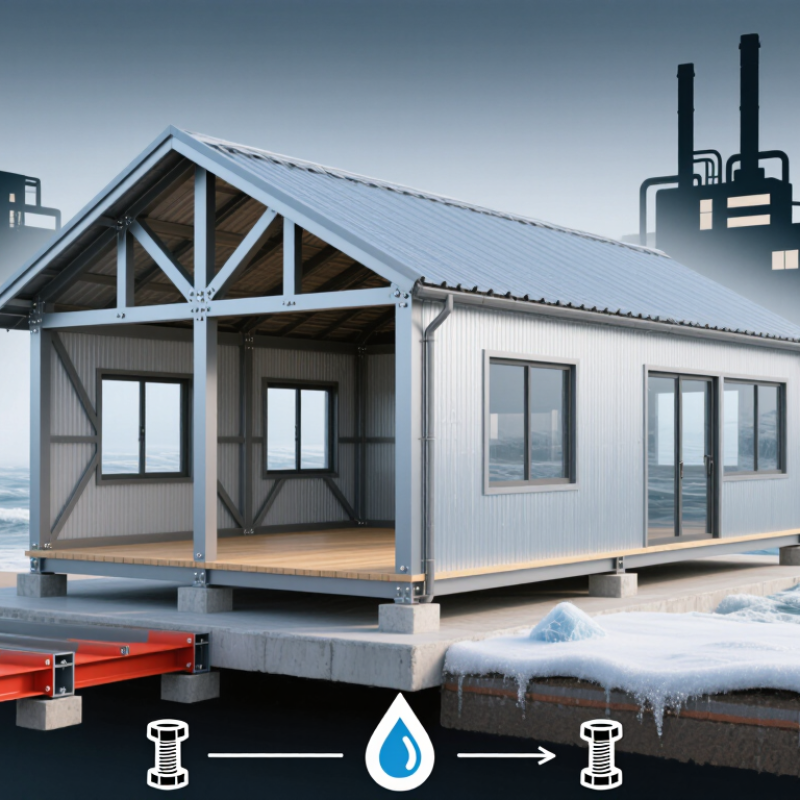
Steel structure prefab houses are homes built from factory-cut steel members, panels, and connecting components. The main frame usually includes columns, beams, roof trusses, and bracing. Walls may contain insulated panels, cement boards, or other approved cladding systems. Unlike a fully modular unit, many prefab houses arrive as labeled parts. Workers assemble them on a prepared foundation.
Durability begins before the frame reaches the site. Engineers check soil conditions, wind exposure, snow loads, drainage, and connection details. Bolts and welds must match the approved drawings. Protective coatings help reduce corrosion, especially around cut edges and joints. Insulation also matters because cold steel can create thermal bridges and interior condensation. A steel frame is not maintenance-free. That assumption causes trouble. In 2026, better detailing can improve service life, but poor installation still weakens performance. I have seen small water leaks become expensive repairs when flashing was rushed.
Tips: Keep rainwater away from the foundation. Inspect roof penetrations after severe weather. Check exposed fasteners for rust. Ask for coating specifications, structural calculations, and installation records. Photograph hidden layers before interior finishes cover them. Local climate matters more than marketing claims. A coastal site needs stricter corrosion protection than a dry inland location. Also, do not treat factory precision as perfection; transport damage and rushed site adjustments still require careful review.
| Dimension | Typical Data or Range | Durability and Construction Relevance |
|---|---|---|
| Primary structural material | Cold-formed or hot-rolled structural steel | Provides high strength-to-weight performance and consistent factory-controlled dimensions. Structural members must be designed for the local building code and site loads. |
| Common design service life | About 50 years for many engineered building designs; longer service is possible with proper maintenance | Service life depends on structural design, corrosion exposure, workmanship, drainage, maintenance, and replacement of weather-exposed components. |
| Structural strength-to-weight ratio | Generally higher than many conventional load-bearing materials | Lower structural mass can reduce foundation loads, while engineered connections transfer wind, seismic, and gravity forces through the complete building system. |
| Typical corrosion protection | Zinc coating, paint system, or a combined protective system | Protection must match the exposure category. Coastal, industrial, persistently damp, and high-salt environments require more rigorous detailing and inspection. |
| Hot-dip galvanized coating reference | A 275 g/m² total zinc coating is approximately 19–20 µm per surface when evenly distributed | Actual corrosion life varies widely with humidity, salt, pollutants, abrasion, and drainage. Cut edges, damaged areas, and field welds need compatible repair protection. |
| Moisture and water management | Continuous water-resistive layer, flashing, sealed joints, and ventilated drainage paths | Preventing trapped moisture is essential. Roof overhangs, correctly sloped surfaces, sealed penetrations, and foundation drainage help reduce corrosion and mold risk. |
| Fire performance | Non-combustible steel, but fire resistance depends on the complete rated assembly | Steel loses strength as temperature rises. Gypsum board, insulation, fire protection, compartmentation, and tested connections determine the required fire-resistance rating. |
| Wind resistance | Project-specific; commonly engineered for local basic wind speed and exposure category | Roof-to-wall connections, wall bracing, anchor bolts, sheathing, and foundations must be designed as one continuous load path. |
| Seismic performance | Dependent on seismic zone, soil conditions, building geometry, ductile detailing, and connection design | Lightweight steel framing can reduce inertial forces, but adequate bracing, diaphragm action, anchorage, and code-compliant connections remain essential. |
| Thermal bridging control | Continuous insulation and thermal-break detailing are typically required | Steel conducts heat efficiently. Without thermal breaks and correctly installed insulation, thermal bridges can increase energy use and surface-condensation risk. |
| Factory prefabrication accuracy | Computer-controlled cutting and preassembly can reduce dimensional variation | Factory production can improve repeatability and reduce site waste, but transport, lifting, field joints, and installation tolerances still affect final performance. |
| Typical construction schedule | Often shorter than fully site-built construction when design, foundations, permits, and manufacturing are coordinated | Prefabrication can reduce weather exposure and on-site labor, but the total schedule still depends on approvals, site preparation, delivery, and utility connections. |
| Recommended inspection frequency | At least annually, plus inspections after severe storms or flooding | Check coating damage, fasteners, roof and wall penetrations, sealants, drainage, condensation, and any areas where dissimilar metals contact. |
| End-of-life recyclability | Steel is widely recyclable and can be recovered from many structures | Bolted, modular, and mechanically connected components may support easier disassembly, reuse, and material recovery than permanently bonded assemblies. |
Note: The figures and ranges are typical industry references, not guarantees. Actual durability must be verified through a site-specific structural design, environmental assessment, product specifications, and local building regulations.
A well-designed house may serve for 50 to 70 years. Its lifespan depends on coatings, drainage, steel thickness, and connection quality. That is an estimate, not a promise.
Yes, salt air can accelerate corrosion around joints, cut edges, and fasteners. Regular freshwater washing helps remove salt deposits. Inspect damaged coatings quickly. Small repairs matter.
Water can enter tiny cracks around foundations, cladding, and fasteners. Freezing water expands and may worsen those defects. A practical service range may be 40 to 60 years, depending on maintenance.
No. Steel loses strength as temperatures rise. At about 600°C, its strength may fall considerably. Fire-resistant boards, insulation, and protected connections should work together. Steel alone is not enough.
Check gutters, roof penetrations, flashing, screw heads, welds, bolts, and base plates. Inspect these areas twice yearly when possible. Look for rust, leaks, loose fasteners, or damaged coatings.
Factory production can improve dimensional accuracy and reduce site errors. It cannot repair poor engineering details. Welds still need inspection, and bolted joints need verified tightening. Small mistakes may cause noise, movement, or water entry years later.
Bathrooms, kitchens, and poorly ventilated cavities can create hidden condensation. Moisture may cause corrosion, mold, or damaged insulation. Thermal inspection can reveal cold spots before problems become visible. Ventilation is easy to underestimate.
Roof edges, foundation interfaces, joints, cut edges, and damaged coating areas need close attention. Poor drainage can trap water against steel members. Keep gutters clear and direct water away from walls. Water always finds a weakness.
Yes, polluted environments may reduce a practical service range to about 25 to 45 years. Soil chemistry, ventilation, and maintenance also affect performance. A climate-specific inspection is more useful than a perfect lifespan claim. Estimates can be wrong.
Durability comes from the whole system, not the steel frame alone. Good detailing, protective coatings, drainage, fire protection, and maintenance must work together. Future alterations can change the original performance. The weakest detail may decide the outcome.
Steel structure prefab houses are factory-produced homes built from engineered steel frames, insulated panels, and prefabricated components that are assembled efficiently on site. Their durability depends on the quality of the steel, connection design, protective coatings, foundation work, insulation, drainage, and construction accuracy. The key question, “how durable are steel structure prefab houses,” cannot be answered by material alone, because climate and maintenance also play major roles. In dry, mild environments, these homes may maintain reliable performance for many decades, while coastal, humid, snowy, or industrial areas require stronger corrosion protection and more frequent inspections.
Long-term durability is supported by routine checks for rust, water leaks, loose connections, damaged coatings, and insulation problems. Repairs should address small defects before they affect structural components. Proper design should also account for wind, earthquakes, snow loads, fire resistance, and thermal movement. Safety standards, material testing, weld inspections, load evaluations, and periodic professional assessments help verify performance over time. With sound engineering, controlled manufacturing, careful installation, and regular maintenance, steel prefab houses can offer stable, safe, and durable residential service.

 Estable Living